
Campus Living Is the Next Great Chapter in Retirement
For generations, the standard trajectory of retirement followed a familiar pattern: downsize, quiet down, and move into an age-segregated neighborhood where everyone shares roughly the same life story. But for an increasing number of adults over 60, that model feels less like a tranquil paradise and more like an artificial bubble.
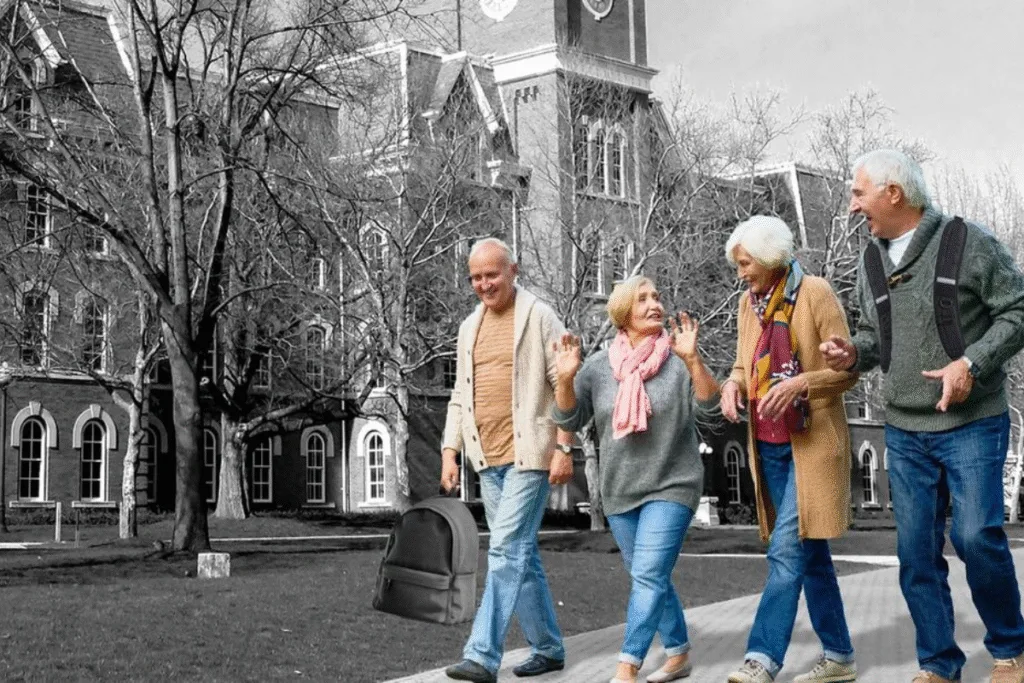
Instead of retreating into isolation, today’s retirees are choosing energy, culture, and connection by moving onto college campuses.
Intergenerational living—where people of different generations intentionally share community spaces—is surging in popularity. At the forefront of this trend are University Retirement Communities (URCs), specialized residential settings located on or directly adjacent to college campuses. It turns out that trading a quiet cul-de-sac for the pulse of university life might just be the secret to a richer, longer, and more fulfilling retirement.
Leaving Behind “Elderly Island”
“They do not want to live on Elderly Island,” explains Andrew Carle, a senior living consultant and founder of UniversityRetirementCommunities.com. The phrase captures a growing sentiment among older adults who refuse to be isolated from the broader, multi-generational world.
Living on or near a university campus replaces age isolation with a dynamic environment. You aren’t just surrounded by peers in your demographic; you are walking alongside 20-something students rushing to class, professors researching cutting-edge science, and young families attending weekend games.
Dr. Matthew Kaplan, a professor of intergenerational programs and aging at Pennsylvania State University, highlights the core benefit: “It’s living in an engaged, less socially isolated way.” When you interact daily with people of different ages, your perspective stays fresh, and your day-to-day life becomes naturally more varied.
The Campus Advantage: Culture, Learning, and Vitality
What makes university living so appealing compared to traditional senior housing? In short: access.
The costs of living in a URC can be comparable to traditional senior living, yet the lifestyle payoff is exponentially higher:
- Lifelong Learning: Many campus communities allow residents to audit university courses for free or at a discount, attend guest lectures, or participate in campus research initiatives.
- Cultural Wealth: You have world-class performing arts centers, museum exhibitions, and concert halls right in your backyard—often just a short walk from your front door.
- Athletics & Fitness: From state-of-the-art recreation facilities to the electrifying energy of college game days, staying physically and socially active is built into the environment.
- Mentorship & Giving Back: Younger generations benefit deeply from the wisdom and life experience of older residents. Many campus setups encourage informal tutoring, career advice, and community volunteering.
As Dr. Kaplan notes, the emotional and cognitive ROI is tangible: “Your life gets more interesting.”
Exploring the Spectrum of Campus Communities
Intergenerational models range from upscale university-affiliated developments to cohousing collectives. Here are a few notable options around the country that showcase how diverse this lifestyle can be:
1. Mirabella at Arizona State University (Tempe, AZ)
Located right in the heart of ASU’s main campus, Mirabella is a 20-story high-rise community. Residents receive university IDs, giving them full access to campus libraries, learning programs, and wellness centers while living directly alongside student energy.
2. Lasell Village at Lasell University (Newton, MA)
For those who take lifelong learning seriously, Lasell Village pioneered an educational requirement model. Every resident commits to at least 450 hours per year of academic learning, teaching, or physical wellness activities.
3. Oak Hammock at the University of Florida (Gainesville, FL)
Set on a lush, 136-acre property near UF, Oak Hammock offers a Continuing Care Retirement Community (CCRC) model. Residents enjoy audit access to UF courses, health-care services backed by the university’s medical system, and extensive nature trails.
4. Cohousing Communities across the U.S.
If a university isn’t your speed, traditional cohousing developments offer another intergenerational route. In these neighborhoods, private units center around shared spaces (gardens, large kitchens, and community centers) designed specifically to foster daily interaction between seniors, working adults, and children.
Beyond “Elderly Island”: Why Campus and Intergenerational Living Is the Next Great Chapter in Retirement
For generations, the standard trajectory of retirement followed a familiar pattern: downsize, quiet down, and move into an age-segregated neighborhood where everyone shares roughly the same life story. But for an increasing number of adults over 60, that model feels less like a tranquil paradise and more like an artificial bubble.
Instead of retreating into isolation, today’s retirees are choosing energy, culture, and connection by moving onto university campuses or into intentional intergenerational neighborhoods.
Intergenerational living—where people of different generations intentionally share community spaces—is surging in popularity. At the forefront of this trend are University Retirement Communities (URCs), specialized residential settings located on or directly adjacent to higher education institutions. It turns out that trading a quiet cul-de-sac for the pulse of academic and cultural life might just be the secret to a richer, longer, and more fulfilling retirement.
Leaving Behind “Elderly Island”
“They do not want to live on Elderly Island,” explains Andrew Carle, a senior living consultant and founder of UniversityRetirementCommunities.com. The phrase captures a growing sentiment among older adults who refuse to be isolated from the broader, multi-generational world.
Living on or near a university campus replaces age isolation with a dynamic environment. You aren’t just surrounded by peers in your demographic; you are walking alongside 20-something students rushing to class, professors researching cutting-edge science, and young families attending weekend games.
Dr. Matthew Kaplan, a professor of intergenerational programs and aging at Pennsylvania State University, highlights the core benefit: “It’s living in an engaged, less socially isolated way.” When you interact daily with people of different ages, your perspective stays fresh, and your day-to-day life becomes naturally more varied.
The Campus Advantage: Culture, Learning, and Vitality
What makes university living so appealing compared to traditional senior housing? In short: access.
The costs of living in a URC can be comparable to traditional senior living, yet the lifestyle payoff is exponentially higher:
- Lifelong Learning: Many campus communities allow residents to audit university courses for free or at a discount, attend guest lectures, or participate in campus research initiatives.
- Cultural Wealth: You have world-class performing arts centers, museum exhibitions, and concert halls right in your backyard—often just a short walk from your front door.
- Athletics & Fitness: From state-of-the-art recreation facilities to the electrifying energy of college game days, staying physically and socially active is built into the environment.
- Mentorship & Giving Back: Younger generations benefit deeply from the wisdom and life experience of older residents. Many campus setups encourage informal tutoring, career advice, and community volunteering.
As Dr. Kaplan notes, the emotional and cognitive ROI is tangible: “Your life gets more interesting.”
Exploring Stateside Campus Communities
In the United States, university-affiliated developments range from high-rise urban settings to expansive suburban campuses:
1. Mirabella at Arizona State University (Tempe, AZ)
Located right in the heart of ASU’s main campus, Mirabella is a 20-story high-rise community. Residents receive university IDs, giving them full access to campus libraries, learning programs, and wellness centers while living directly alongside student energy.
2. Lasell Village at Lasell University (Newton, MA)
For those who take lifelong learning seriously, Lasell Village pioneered an educational requirement model. Every resident commits to at least 450 hours per year of academic learning, teaching, or physical wellness activities.
3. Oak Hammock at the University of Florida (Gainesville, FL)
Set on a lush, 136-acre property near UF, Oak Hammock offers a Continuing Care Retirement Community (CCRC) model. Residents enjoy audit access to UF courses, health-care services backed by the university’s medical system, and extensive nature trails.
A website to search for options: URC University Retirement
Taking the Concept Abroad: European Models & Slow Travel
For those looking beyond U.S. borders, intergenerational and campus-adjacent living is taking on creative new shapes across Europe, driven by civic design and cultural immersion:
4. House of Generations (Aarhus, Denmark)
This pioneering municipal project in Denmark brings nursery children, university students, and retirees under one roof. Residents share communal kitchens, workshops, and fitness spaces designed specifically to foster daily, cross-generational interaction.
5. Intergenerational Cohousing via CoHabitat Foundation (Europe-wide)
European cohousing projects often weave older adults directly into neighborhood developments alongside young families and students. Projects in cities across Spain, Germany, and the Netherlands emphasize shared common spaces, cooperative management, and affordable multi-generational living.
6. Extended “Study Abroad” for Seniors via The Good Life Abroad
If committing to permanent relocation abroad feels like too big a leap, month-long urban immersion programs allow adults 55+ to rent central apartments in cities like Florence, Lisbon, or Barcelona. Participants get built-in local community networks, language practice, and university-level cultural seminars.
Key Questions to Consider Before Making the Leap
Transitioning from a traditional family home of several decades into an intentional or university community is a major life pivot. Real estate broker Juli Ford, who specializes in senior housing transitions, emphasizes that clarity is key before signing any contracts.
Here are the critical factors to evaluate:
- How much social interaction do you actually want?Do you want high-density interaction where you share common dining halls or community events daily? Or do you prefer private housing situated near a campus where you can opt into activities when you choose?
- What is the programming structure?Does the community feature formal programs designed to connect older adults with students and faculty, or is the integration entirely self-directed?
- Are you clear on the financial model?Financial structures in intergenerational living vary wildly. Some communities require a large upfront entrance fee (a portion of which may be returned to your estate when you leave), while others operate as co-ops where you buy equity shares. Rental options offer greater flexibility without locking up capital.
- What is your exit plan?If you purchase into a new development, ask what happens to your investment if the project struggles or if your medical needs require you to move away.
Estimated Costs by Region
Universities generally accommodate older adults through two models: Lifelong Learning Programs (day/audit courses with nearby or on-campus housing) and University-Based Retirement Communities (UBRCs) (dedicated senior living developments tied directly to campus academic and social life).
| Region / University Example | Course Fees | Monthly Accommodation | Notes & Models |
| United States (e.g., Arizona State Univ., Duke Univ., Stanford) | $65 – $350 / term (Osher Lifelong Learning Institutes / Auditing) | $2,500 – $6,500+ / mo (Independent living in UBRCs like Lasell Village or Kendall at Oberlin) | – Non-credit auditing is often heavily discounted or free for state residents over 60–65. – On-campus senior living communities (UBRCs) bundle housing, dining, and campus amenities. |
| United Kingdom (e.g., Univ. of Oxford, Univ. of Cambridge, Kings College) | £200 – £1,500 / module (Continuing Education / Short Courses) | £800 – £2,200 / mo (Private rentals/serviced apartments near campus) | – Degree-level tuition ranges £9,250–£20,000+/year. – Senior housing is rarely directly managed by universities; retirees typically secure nearby private flats or retirement apartments. |
| European Union (e.g., Univ. of Valencia / Univ. Senior Programs in Spain, France, Germany) | €50 – €400 / year (Public University Senior Programs / “Universidad de Mayores”) | €600 – €1,800 / mo (Independent rental / Senior residence) | – Extremely affordable lifelong learning initiatives hosted directly by public universities. – Intergenerational co-housing programs exist in places like the Netherlands and Spain, trading shared social hours for subsidized rent. |
| Asia (e.g., National Univ. of Singapore, Univ. of Tokyo, Mahidol Univ. Thailand) | $100 – $600 / course (Executive/Lifelong Learning modules) | $800 – $3,000 / mo (Serviced apartments or senior living facilities nearby) | – Singapore offers government-subsidized lifelong learning schemes for older residents. – On-campus dormitories strictly limit non-degree senior housing; private apartments nearby are standard. |
Key Structural Differences
- Courses: Senior auditing or lifelong learning programs allow retirees to attend lectures without standard degree application stress or full tuition costs. Full-degree tracks follow regular international or domestic student fee structures.
- Accommodation: Full “campus living” for seniors is most structured in the US via formal UBRCs. In Europe and Asia, senior students typically rent nearby apartments or reside in specialized senior developments near the university town rather than student dorms.
A Way to Thrive, Not Just Retire
Retirement shouldn’t mean turning down the volume on life—it should mean tuning into new frequencies. Choosing a university or intergenerational setting offers a powerful antidote to modern isolation, giving older adults a front-row seat to innovation, youthfulness, and lifelong growth.
If you’re ready to trade routine maintenance for a vibrant lifestyle, taking a look at a campus community might be the best assignment you ever give yourself.